




 Send Inquiry
O Dianisidine
Price 1 INR/ Kilograms
O Dianisidine Specification
- HS Code
- 2921
- Ingredients
- O-Dianisidine (3,3-Dimethoxybenzidine)
- Storage
- Store in tightly sealed container, away from light and moisture
- Melting Point
- 131 - 135C
- CAS No
- 119-90-4
- Poisonous
- YES
- Shelf Life
- 2 years
- Molecular Weight
- 244.29 g/mol
- Smell
- Odorless
- Shape
- Crystalline
- Application
- Used as a reagent in analytical chemistry, staining agent in biology
- Physical Form
- Powder
- Molecular Formula
- C14H16N2O2
- Solubility
- Slightly soluble in water, soluble in alcohol and ether
- Usage
- Peroxidase substrate, diazo dye precursor
- Purity
- 98%
- Appearance
- Light brown to reddish powder
- EINECS No
- 204-355-2
- Product Type
- Chemical
- Properties
- Analytical reagent grade; Light sensitive; Possible mutagenicity
- Grade
- Laboratory
- Density
- 1.17 Gram per cubic centimeter(g/cm3)
- Structural Formula
- (Image available in linked URL)
- Synonyms
- O-Dianisidine, o-Dimethoxybenzidine
- Particle Size
- Typically 10-40 mesh
- Handling Precautions
- Use appropriate personal protective equipment; avoid inhalation
- IUPAC Name
- 3,3'-Dimethoxybenzidine
- Color Index Number
- Not assigned
- Hazard Statements
- Suspected of causing cancer; Toxic if swallowed or inhaled
- Stability
- Stable under recommended storage conditions
- Environmental Hazard
- Classified as hazardous waste
- Pack Type
- HDPE bottle or drum
- Vapor Pressure
- Negligible
O Dianisidine Trade Information
- Minimum Order Quantity
- 25 Kilograms
- Supply Ability
- 100 Kilograms Per Week
- Delivery Time
- 1 Week
About O Dianisidine
O DIANISIDINE
Features:
- Accurate pH value
- High effectiveness
- Non-toxic nature
- Longer shelf life
Applications and Benefits
O-Dianisidine is valued in laboratories for its versatility, serving as a substrate for peroxidase enzyme assays, a precursor in dye production, and a staining agent in biological research. Its high purity ensures reliable results, while its stability guarantees consistent performance over a two-year shelf life.
Safe Storage and Handling
Due to its toxic and potentially carcinogenic properties, O-Dianisidine must be handled with appropriate personal protective equipment. It should be stored in tightly sealed containers, away from light and moisture, to preserve product integrity and maintain safety throughout handling and use.
Physical Properties and Packaging
Supplied as an analytical grade powder with a particle size of 1040 mesh, O-Dianisidine is odorless and light sensitive. It is typically packaged in HDPE bottles or drums to ensure chemical stability and minimize environmental impact, as it is classified as hazardous waste.
FAQs of O Dianisidine:
Q: How is O-Dianisidine used in laboratory applications?
A: O-Dianisidine is commonly employed as a reagent in analytical chemistry, serving as a substrate for peroxidase enzyme assays and as a staining agent in biological studies. It is also utilized as a precursor in the synthesis of diazo dyes.Q: What safety precautions should be followed when handling O-Dianisidine?
A: Handle O-Dianisidine using appropriate personal protective equipment, such as gloves, goggles, and a lab coat. Avoid inhalation and direct contact with the skin, and always work in a well-ventilated area or a chemical fume hood.Q: When and where should O-Dianisidine be stored to maintain stability?
A: Store O-Dianisidine in a tightly sealed HDPE container, away from direct light and moisture. Proper storage in a cool, dry location will help maintain its stability and effectiveness throughout its two-year shelf life.Q: What are the health and environmental hazards associated with O-Dianisidine?
A: O-Dianisidine is toxic if swallowed or inhaled and is suspected of causing cancer and possible mutagenicity. It is also classified as hazardous waste, requiring careful disposal according to local regulations to minimize environmental risks.Q: How does the physical form of O-Dianisidine affect its usage?
A: O-Dianisidine is supplied as a light brown to reddish crystalline powder with negligible vapor pressure. Its particle size (typically 1040 mesh) allows for easy measurement and mixing in laboratory protocols.Q: What is the benefit of using analytical reagent grade O-Dianisidine?
A: Analytical reagent grade O-Dianisidine offers high purity (98%), ensuring accurate and reliable experimental results across various laboratory and research applications.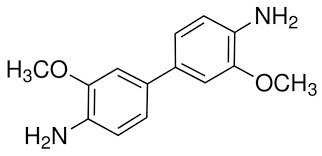

Price:
- 50
- 100
- 200
- 250
- 500
- 1000+

More Products in Lab Chemicals Category
C Resol Red Free Acid
Price 1 INR / Kilograms
Minimum Order Quantity : 25 Kilograms
Ph Level : Neutral to slightly acidic
Melting Point : 222C
CAS No : 62625290
Poisonous : Other, Nonpoisonous under normal handling
Orcein
Price 1 INR / Kilograms
Minimum Order Quantity : 25 Kilograms
Ph Level : 6.0 6.5 (aqueous solution)
Melting Point : 205C (decomposes)
CAS No : 1400620
Poisonous : Other, Nontoxic
Agar Agar
Price 1 INR / Kilograms
Minimum Order Quantity : 25 Kilograms
Ph Level : 6.0 7.5 (1% solution)
Melting Point : ~85C (gels at 3240C, melts at 8595C)
CAS No : 9002180
Poisonous : Other, Nonpoisonous
Cupron
Price 1 INR / Kilograms
Minimum Order Quantity : 25 Kilograms
Ph Level : 4.05.0
Melting Point : 110C (decomposes)
CAS No : 7758987
Poisonous : Other, Nonpoisonous if used as directed

GST : 27AARCA1049D1ZS


|
 |
KARAN LABORATES
All Rights Reserved.(Terms of Use) Developed and Managed by Infocom Network Private Limited. |
